
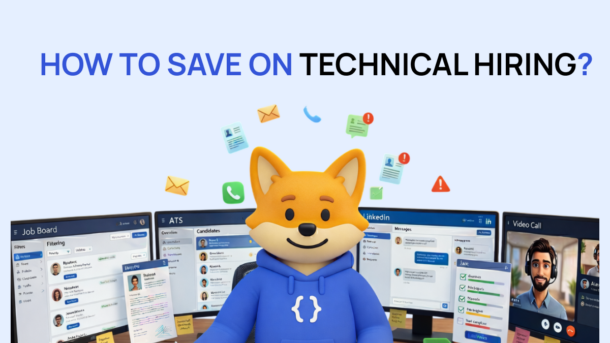
Technical hiring is one of the most expensive parts of building a team. We’ve been talking to hiring teams lately and one pattern keeps coming up.
A company needs to hire a backend developer. The internal recruiter is strong, great at sourcing, great with people, knows how to read a candidate. But they don’t have the technical background to run the interview themselves. So they do what most companies do: bring in an external tech expert.
$50–150 per interview. Sometimes more. Multiply that by 5 candidates per role, 3 open roles at a time, and you’re looking at $750–2,250 just to get through a hiring cycle. Before a single offer is made.
And that’s when everything goes smoothly.
Outsourced technical interviews solve one problem, technical knowledge, but create several others.
The recruiter loses visibility into what actually happened during the interview. They get a verdict: pass or fail. Sometimes a few notes. But they can’t learn from the process, can’t coach the next interviewer, can’t improve the questions for the next round.
The external expert brings their own standard question set. Which may or may not fit this specific role, this specific stack, this specific seniority level. A React developer interview at a startup looks very different from the same interview at an enterprise company. A generic question set won’t catch that difference.
And the follow-up questions, the ones that reveal whether a candidate actually understands something or just memorized the right words, those depend entirely on the individual interviewer. Some ask them. Some don’t.
The result: good engineers get screened out by the wrong questions. Average candidates pass because they knew the standard answers. And the recruiter has no way to know which happened. 😬
❌ What most technical hiring teams are missing
The problem isn’t that recruiters lack technical knowledge. The problem is that they lack structure.
A recruiter who walks into a technical interview with the right questions, tailored to the role, the stack, and the seniority level, and knows what a good answer looks like, can run a solid technical screen without a computer science degree.
They don’t need to know how to implement a binary search tree. They need to know what question to ask, what a strong answer sounds like versus a weak one, and what to follow up with when the candidate’s answer is vague.
That’s a structure problem. And structure can be provided.
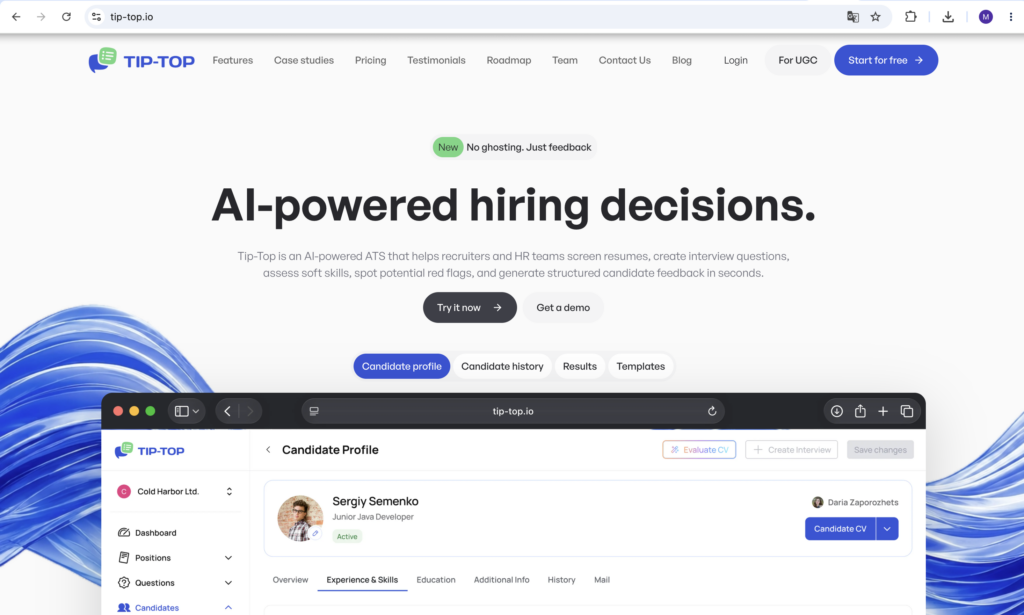
✅ This is exactly what we built Tip-Top for
Before each interview, Tip-Top generates a structured set of questions based on the role, tech stack, and seniority level. Not generic questions, specific ones. React vs Vue. Junior vs Senior. Frontend at a product company vs a dev shop.
And next to each question: the answer 💡. What a strong response looks like. What red flags to watch for. What follow-up to ask if the candidate’s answer needs probing.
The recruiter walks into the interview prepared. They know what they’re looking for. They know when to dig deeper. They don’t need an external expert in the room, because the expertise is already built into the process.
After the interview, Tip-Top generates structured candidate feedback automatically ⚡. The recruiter has everything they need to make a decision and communicate it clearly, without spending another hour writing notes.
According to LinkedIn’s Global Talent Trends, structured interviews are 2x more predictive of job performance than unstructured ones. Yet most companies still rely on ad-hoc technical hiring processes.
💰 What this actually saves
For a company running 10 technical interviews per month at $50–150 each, that’s $500–1,500/month on external interviewers. Tip-Top Pro costs $15/month for the whole team.
But the real saving isn’t the money. It’s the visibility. The consistency. The ability to compare candidates using the same criteria, improve your process over time, and stop treating every technical interview like a black box you hand off to someone else.
Recruiters are good at their jobs. They just need the right tools to do the technical part of that job well 🎯
That’s what Tip-Top is for.
Want to see how other companies improved their hiring process? Read https://tip-top.io/#cases.
Try it free for 7 days → tip-top.io

 ChatGPT
 Perplexity
 Claude
 Calendly