
When comparing Tip-Top vs PeopleForce, you’re looking at two platforms that serve HR teams but solve fundamentally different problems. PeopleForce is a full-cycle HRM system trusted by 1,600+ companies in 25+ countries. Tip-Top is an AI-powered ATS built specifically around the interview process. Both have recruiting modules. But the depth and focus differ significantly.
This Tip-Top vs PeopleForce comparison breaks down features, pricing, and which platform makes more sense for your team.
🔍 What each tool is built for
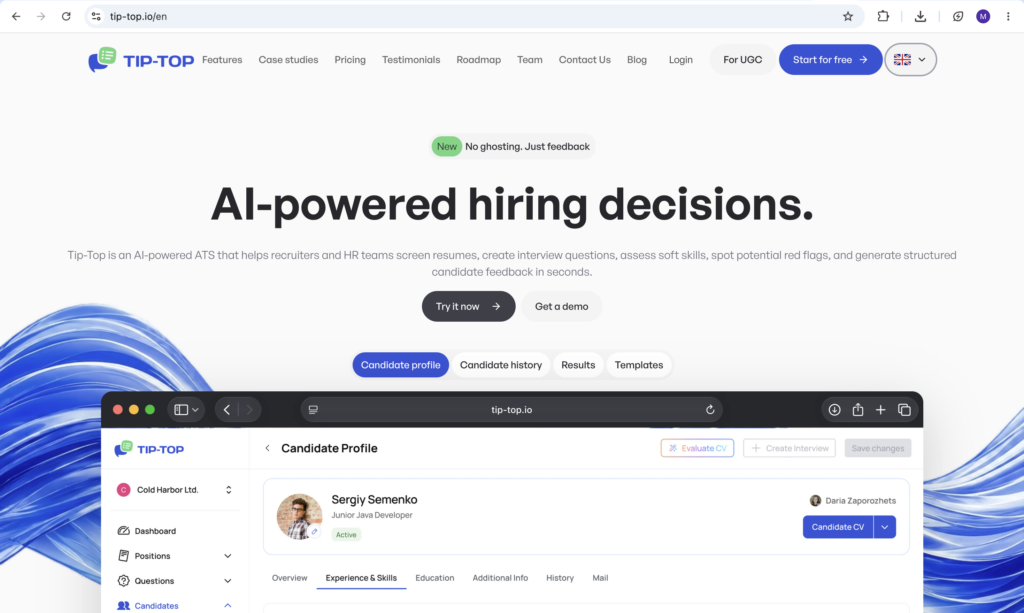
Tip-Top is an AI-powered ATS focused on the interview process. It helps recruiters and HR managers screen resumes, generate structured interview questions, assess soft skills, detect red flags, and deliver candidate feedback in seconds. The full hiring workflow from opening a position to sending feedback to a rejected candidate happens in one place.
PeopleForce is a comprehensive HRM platform built around the full employee lifecycle. Its modules cover recruiting (Recruit), core HR (CoreHR), performance management (Perform), employee surveys (Pulse), helpdesk (Desk), and time tracking (Time). It’s designed for companies that want one platform for everything from sourcing a candidate to managing their performance reviews years later.
In the Tip-Top vs PeopleForce comparison: Tip-Top is a focused interview and evaluation tool. PeopleForce is a full HRM suite where recruiting is one of seven modules.
⚡ Tip-Top vs PeopleForce: Features comparison
🎯 Candidate sourcing
PeopleForce’s Recruit module supports vacancy management, candidate pipeline tracking, and integrations with job boards. The platform connects with Slack, Google, and Microsoft calendars. Candidates move through customizable stages, and the full candidate-to-employee journey happens within one system.
Tip-Top has CV parsing and a LinkedIn extension for importing candidate profiles directly into the ATS. For IT-focused hiring, the LinkedIn import covers the primary sourcing workflow effectively.
Winner: PeopleForce for teams that need full-cycle sourcing within a broader HR platform. Tip-Top for leaner, interview-focused workflows.
📋 Interview preparation
In the Tip-Top vs PeopleForce comparison, this is where Tip-Top clearly leads. Tip-Top generates structured interview questions automatically based on role, seniority level, and tech stack using AI. Recruiters get a ready-made question set before every call from AI or from a library of templates. No manual prep needed.
PeopleForce’s Recruit module manages candidates through pipeline stages but doesn’t generate interview questions automatically. Preparation remains the recruiter’s responsibility.
Winner: Tip-Top. If structured interviews and AI-assisted preparation matter, Tip-Top handles it directly.
🤖 AI-powered feedback
After every interview in Tip-Top, the platform generates structured candidate feedback automatically in seconds. The recruiter reviews it and sends it to the candidate. This removes one of the biggest time drains in hiring: writing feedback manually after back-to-back calls.
PeopleForce tracks candidates and collects notes during the hiring process, but doesn’t generate post-interview feedback automatically.
Winner: Tip-Top for post-interview feedback speed. In the Tip-Top vs PeopleForce comparison, this is a clear differentiator for teams hiring at pace.
🚩 Soft skills and red flags
Tip-Top identifies communication patterns, behavioral cues, and inconsistencies between what a candidate says during the interview and what’s in their CV. Potential red flags get flagged automatically, helping HR teams make more objective hiring decisions.
PeopleForce doesn’t offer automated soft skills detection or behavioral analysis during the interview itself.
Winner: Tip-Top for automated soft skills detection and red flag identification.
📊 Pipeline and candidate management
Both platforms offer candidate pipeline management. PeopleForce’s Recruit module supports customizable hiring stages, role-based access, and keeps the candidate’s full journey visible from first application to becoming an employee. Reviewers on G2 consistently praise how intuitive and flexible the pipeline is.
Tip-Top has a Candidate Hub for assigning interviews, tracking evaluation progress, and viewing full candidate history. The Autosuggestion feature surfaces candidates from your database automatically when a new position opens, filtered by skills, experience, and role requirements.
Winner: Tie. PeopleForce goes deeper on full employee lifecycle management. Tip-Top goes deeper on interview evaluation and AI-driven candidate matching.
👥 HR management (post-hire)
This is where PeopleForce has no competition from Tip-Top. PeopleForce covers onboarding and offboarding automation, absence management, OKR and KPI tracking, performance reviews, 360-degree feedback, employee surveys, e-signatures, document management, and time tracking. The platform claims to automate up to 80% of HR processes, saving teams 80 hours per month.
Tip-Top focuses entirely on hiring. Once a candidate is hired, that’s the end of what Tip-Top tracks.
Winner: PeopleForce for everything post-hire.
📈 Hiring analytics
Tip-Top’s Reports section covers Vacancy Funnel, User Activity, Recruiter Statistics, Position Analysis, Sourcing ROI, Recruitment Funnel, Pipeline Velocity, Drop-off Analysis, and Offer Acceptance Rate, available on all plans.
PeopleForce offers analytics across all its modules: HR metrics, performance data, attendance reports, and hiring funnel data. The depth depends on which modules you use.
Winner: Tie. Tip-Top goes deeper on interview-specific metrics. PeopleForce offers broader HR analytics across the full employee lifecycle.
🔗 Integrations and security
PeopleForce integrates with Slack, Google Workspace, Microsoft 365, and has API access. It holds ISO 27001:2013 certification with servers in Frankfurt, Germany, and full GDPR compliance. The platform has a 98.2% customer satisfaction rate and responds to support requests in an average of 2 minutes.
Tip-Top integrates with Google Meet for interview booking and has a LinkedIn Chrome extension. API access is available on Pro and above.
Winner: PeopleForce for integration breadth, enterprise security certifications, and support speed.
💰 Tip-Top vs PeopleForce: Pricing
When comparing Tip-Top vs PeopleForce pricing, the models are very different.
Tip-Top prices per company, not per user:
- Basic — $8.50/mo per company (3 users, 100 candidates, 20 positions)
- Pro — $15/mo per company (10 users, 1,000 candidates, 100 positions, full AI features)
- Business — $28/mo per company (100 users, unlimited candidates and positions)
- Enterprise — Individual pricing, unlimited everything
7-day free trial on Pro. No credit card required.
PeopleForce prices per employee per month, with a minimum of 50 employees:
- Standard — from $2/employee/mo (CoreHR module)
- Professional — from $2.50/employee/mo (CoreHR with advanced automation)
- Recruit, Perform, Pulse, Time, and Desk modules are priced separately on top
For a company of 50 employees using CoreHR Standard, the base cost is $100/mo. Add the Recruit module, Perform module, and others, and the total quickly reaches $300-500/mo or more depending on modules selected.
For a small HR team focused on hiring: Tip-Top Pro costs $15/mo for the whole team. PeopleForce with just the CoreHR and Recruit modules starts at $100/mo for 50 employees minimum.
Winner: Tip-Top on price for small and mid-sized teams that need a focused hiring tool. PeopleForce offers more value per dollar if you need the full HRM suite.
🎯 Tip-Top vs PeopleForce: Who each tool is for
Tip-Top makes sense if:
- Your team runs structured interviews and wants AI-generated questions ready before each call
- You want automatic candidate feedback generated in seconds after every interview
- You need soft skills detection and behavioral red flag analysis during hiring
- You want solid hiring analytics without paying for a full HRM suite
- Price matters — $15/mo for a full team vs $100+ for PeopleForce’s base plan
PeopleForce makes sense if:
- You need a single platform to manage the full employee lifecycle from recruiting to offboarding
- Your HR team handles performance management, OKRs, attendance, surveys, and helpdesk alongside recruiting
- You’re a company with 50+ employees that wants to automate broad HR operations
- GDPR compliance with ISO 27001 certification is required
- You’re based in Ukraine and want a platform with strong local support and Ukrainian-language interface
✅ Tip-Top vs PeopleForce: The bottom line
When comparing Tip-Top vs PeopleForce, these tools are built for different problems and different team sizes.
PeopleForce is a comprehensive HRM platform for companies that want to manage everything in one place. From the first job posting to an employee’s performance review three years later, PeopleForce covers it all. For Ukrainian companies specifically, it also offers strong local support, a Ukrainian-language interface, and relevant compliance features. But it starts at $100/mo for 50 employees minimum and requires separate module subscriptions for each HR function.
Tip-Top focuses on a narrower problem: making every interview faster, more structured, and more consistent. And it does it with more advanced AI features than PeopleForce currently offers across every stage of the hiring process — AI-generated interview questions, automatic post-interview feedback, soft skills detection, CV parsing, Position Autofill, Autosuggestion of candidates from your database, and an AI assistant that provides hiring analytics and insights. It starts at $15/mo for a full team, has a 7-day free trial with no credit card, and is live in minutes.
For teams who want better interviews and structured candidate feedback without paying for a full HRM platform they don’t need, Tip-Top is the more focused and significantly more affordable choice.
Try Tip-Top free for 7 days → tip-top.io
 ChatGPT
 Perplexity
 Claude
 Calendly